Haven't posted in a while. This video was shared with me by a friend. It is a hilarious and very accurate take on medical school lectures. Thanks to those at Washington University in St. Louis for making this. It was a relief to know that the plight of medical students is universal.
Tuesday, February 28, 2012

Monday, December 19, 2011
"I should've brought you a sedative." -- Medicine in the Sherlock Holmes: A Game of Shadows
 |
| Holmes and Moriarty meet in person for the first time. A good scene. |
My holiday break just started and naturally the first holiday movie I saw this season was Sherlock Holmes: A Game of Shadows. This is the sequel to the 2009 film Sherlock Holmes with Robert Downey, Jr. and Jude Law, certainly one of my top pair of actors to play Holmes and Watson. The story is based partially on Doyle's The Final Problem which ends with Holmes and Moriarty falling over Reichenbach Falls. This was a highly enjoyable movie and a great way to start my break.
That being said, medical fact, as usual, takes a backseat in Hollywood. Nothing major in this film. Only that Holmes drinks formaldehyde, a pretty significant poison. According to the Agency for Toxic Substances & Disease Registry, as little as 1 oz. of a 37% solution of formaldehyde is lethal. The chemically affluent Holmes would have known that.
Holmes also has a cardiac arrest in the movie, although I am not sure why. He was injured and ran through a German forest while under a lot of heavy fire but he didn't bleed out that much. Nevertheless, it was fortunate that Watson had Holmes' wedding present, a shot of adrenal gland extract.
Overall, neither of these events in the movie were that significant. As before, the film paid a lot of respect to Doyle's stories while bringing a fresh take that is lead in large by Downey's interpretation of the character. Also, Stephen Fry as Mycroft Holmes was a definite plus.
Sunday, December 11, 2011
The Physician's Library: 2011 in Review
2011 has been a very medical year for me. For the first time in a long time I have seen myself grown a lot as I transistioned from my first year to second year of medical school. Here's a bit of the year in review in some of the best medically-related things that I encountered this year:
 Medcine in fiction: The Citadel by A.J. Cronin.
This year, I gained a new literary hero in A.J. Cronin who I imagine will be largely unknown to American audiences. I have written about Cronin before and cannot encourage my colleagues enough to read this book. Cronin is not only writes with great artistry but touches on issues that I am sure he observed in medicine as a doctor, himself. Many of those issues still exist today, almost 90 years since the novel was written.
Medicine in non-fiction: Every Patient Tells a Story by Dr. Lisa Sanders
 Again, this is another book I have written about previously and another highly recommended book for medical students. There are plenty of reasons medicine can be enjoyable but Sanders' top reason is very much my own: the detective work of medicine that leads to diagnosis. In a series of real life cases of difficult diagnoses, Sanders illustrates how important history taking, technology, and the physical exam all generate key data that lead to a final conclusion.
Medicine in TV: The first of half of Season 7 of House, MD
 Honestly, it's been difficult for me to get through the second half of Season 7 (post-break-up with Cuddy) because House has regressed a lot, negating the personal progress that was nice to see in Season 6. The medicine in some of the first episodes of Season 7 was decent, too.
Medical Teacher: Dr. Edward F. Goljan
 People will tell you different things when it comes to USMLE Step 1 Prep but there are two constants: First Aid for the USMLE Step 1 by Dr. Tao Le, et al. and, my personal favorite, Rapid Review: Pathology by Dr. Edward Goljan. Not only is Dr. Goljan's book great but so are his audio lectures. Dr. Goljan is every medical student's dream professor not because he is an easy tester (probably far from it) but because he tries to get his students to think like doctors and integrate multiple facets of medicine into pathological concepts.
Person in Medicine: Dr. Atul Gawande
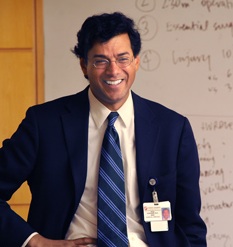
 I have had the great opportunity to listen to Dr. Gawande lecuture twice this year. If you follow my blog you will know that I have posted a lot on his work, which I have enjoyed a lot since discovering it a few years ago. Dr. Gawande is the de facto voice of reason in medicine today. He has no political agenda or advocates for any position other than "this is what evidence is showing might work - let's try it."

This year, I gained a new literary hero in A.J. Cronin who I imagine will be largely unknown to American audiences. I have written about Cronin before and cannot encourage my colleagues enough to read this book. Cronin is not only writes with great artistry but touches on issues that I am sure he observed in medicine as a doctor, himself. Many of those issues still exist today, almost 90 years since the novel was written.
Medicine in non-fiction: Every Patient Tells a Story by Dr. Lisa Sanders

Medicine in TV: The first of half of Season 7 of House, MD

Medical Teacher: Dr. Edward F. Goljan

Person in Medicine: Dr. Atul Gawande
Friday, December 9, 2011
Doyle Syndrome
 Today, I had the fortune of meeting a patient with Marfan's syndrome. The disease is officially named after the French physician Antoine Marfan but almost a decade earlier Sir Arthur Conan Doyle had created a villain who was very likely to have the condition in his very first Sherlock Holmes story, A Study in Scarlet. Doyle, through the voice of Watson, described the character of Jefferson Hope as a tall man in his late thirties who an aortic aneurysm. These are common features seen in Marfan's syndrome which is now known to be a connective tissue disorder. As Doyle was a physician, himself, he frequently had very clinical descriptions of characters (probably the most accurate in all of fiction) and it is likely he had made an association between very tall, slender individuals and aortic aneurysms.
 Monday, December 5, 2011
"Ventricular Tachycardia. Digitalis"

Monday, November 28, 2011
Gawande Part II
If you missed my previous post, I recently had another chance to hear Dr. Atul Gawande speak, this time at the University of Akron. Last time, I posted my initial impressions surrounding Dr. Gawande's promotion of the idea of coordinated, team-based medical care as the solution to what he has called the "appallingly patched-together ship" of American healtchare.
Today, I want to discuss Dr. Gawande's ideas for getting the "cowboys" of medicine to form "pit-crews". I recently found out that this was not the first time that Dr. Gawande has shared this idea; he gave a similar speech at Havard's commencement which was posted online at The New Yorker. In summary, Dr. Gawande identifies three skills necessary for a "pit crew" to function successfully as a system:
1) the ability to recognize successes and failures,
2) the ability to devise solutions
3) the ability to implement solutions on a wide scale.
He also enumerates three values that members of the team need to share:
1) humility to understand that you can fail,
2) discipline to stick to standards to minimize failures
3) teamwork to allow others to save you from failure.
The difficulty in implementing solutions to the problems in healthcare today is that not every physician is on board with these values and it will be no easy task to convince everyone that this is what needs to be done, even with solid supporting evidence. What Dr. Gawande is calling for is a cultural change in the profession of medicine and, to me, that is one of the most difficult changes to incite. With cultural change, you cannot create policies that dictate people's values. The values need to be internalized by all.
I would have really liked to hear Dr. Gawande's ideas for integrating discussion of these values in medical school. At my own school, there is already a significant amount of time devoted to exploring values of medical practice so it would not be difficult to begin such discussions. If any effective culture change is to be made, medical education must definitely be a target area. After all, this is where a physician's enculturation begins.
Today, I want to discuss Dr. Gawande's ideas for getting the "cowboys" of medicine to form "pit-crews". I recently found out that this was not the first time that Dr. Gawande has shared this idea; he gave a similar speech at Havard's commencement which was posted online at The New Yorker. In summary, Dr. Gawande identifies three skills necessary for a "pit crew" to function successfully as a system:
1) the ability to recognize successes and failures,
2) the ability to devise solutions
3) the ability to implement solutions on a wide scale.
He also enumerates three values that members of the team need to share:
1) humility to understand that you can fail,
2) discipline to stick to standards to minimize failures
3) teamwork to allow others to save you from failure.
The difficulty in implementing solutions to the problems in healthcare today is that not every physician is on board with these values and it will be no easy task to convince everyone that this is what needs to be done, even with solid supporting evidence. What Dr. Gawande is calling for is a cultural change in the profession of medicine and, to me, that is one of the most difficult changes to incite. With cultural change, you cannot create policies that dictate people's values. The values need to be internalized by all.
I would have really liked to hear Dr. Gawande's ideas for integrating discussion of these values in medical school. At my own school, there is already a significant amount of time devoted to exploring values of medical practice so it would not be difficult to begin such discussions. If any effective culture change is to be made, medical education must definitely be a target area. After all, this is where a physician's enculturation begins.
Wednesday, November 16, 2011
"Cowboys vs. Pit Crews" - Dr. Atul Gawande Speaks at the University of Akron
 |
| Dr. Atul Gawande at the University of Akron, taken from my "wonderful" camera phone. |

One of the core messages that Dr. Gawande has spoken and wrote much about is just how complex healthcare has become as it has advanced the science behind medicine. He cited a study from a collegue: in 2000 the average patient saw 15 doctors at the hospital to resolve their issue. But the problem is not so much the number as the lack of coordination. Dr. Gawande talked about how physicains have been historically trained as "cowboys" who act independently of other physicians. I believe this is deep seated belief not only in the professional culture but in the cultural perceptions of medicine among our patients. To make my point, I will point to Sir Luke Fildes famous painting The Doctor.
 |
| The Doctor by Sir Luke Fildes |
But I think the picture should be very different if it were commissioned today. I believe Dr. Gawande would agree because as he said last night, we can no longer have "cowboys" with the complexity of healthcare today. Instead, we need teams of physicians, nurses, and other healthcare workers caring for patients in a coordinated fashion. Those fifteen doctors who see you at the hospital need to be talking to each other. We need "pit crews", says Dr. Gawande. If Sir Fildes were to make his painting today you might see a group of doctors, pharmacists, and nurses huddled together, hopefully with the child's parents as part of the discussion. Instead of The Doctor, we would have The Healthcare Team (The Doctors has been taken by a television talk show of incredibly photogenic physicians and again, I would be remiss to not include pharmacists, nurses, and the patient's family).
The "pit crew" or healthcare team is at the center of Dr. Gawande's vision of a systems-based approach to medicine. He illustrated in several stories that where outcomes go bad is not when patients see an individual specialist but in between. Each doctor assumes another one will check these lab findings or start the appropriate antibiotic prophylaxis. But in the end none of them do and easily prevented complications arise. When I say easy, I mean stuff medical students like myself even know because it has be stressed to us that much in our training.
Speaking of which, my studies seem to never end. For the sake of keeping my ideas succint and my time studying optimal, I will leave you with these initial thoughts of mine for now. I will likely have at least another follow up post with some more ideas from this talk.
 |
| TO BE CONTINUED... |
Subscribe to:
Posts (Atom)