Showing posts with label Medicine in TV. Show all posts

Saturday, September 3, 2011

Good Episodes of House, M.D.: Occam's Razor

From a medical science standpoint, this is a pretty solid episode (there are the usual missteps that I chalk up to television being television). The patient, Brandon, presents with an unusual set of symptoms that the team cannot explain with one disease. House initially proposes that there are two processes going on: a sinus infection and hypothyroidism. Foreman brings up Occam's Razor, the philosophical principle that has been adopted in medicine as "the simplest explanation is often the most likely one." The principle of Occam's Razor is actually more accurately described as, when facing competing hypotheses, the one that makes the fewest new assumptions should be selected.

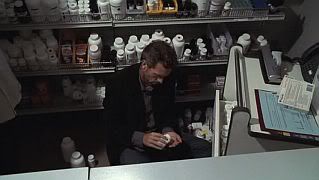
Anyway, Brandon starts to feel a little better and then his white blood cell count drops dangerously low and is put into isolation. After finding inspiration in almost picking up the wrong bottle on a Vicodin run, House spends quite a bit of time considering a new hypothesis. He admits that the principle of Occam's Razor still held and that colchicine poisoning due to a pharmacy mix-up for cough medicine explains all the symptoms. Additionally, Brandon got worse because someone continued to give Brandon his "cough medicine". The team hits a snag when Brandon's mother claims that the cough medicine was a round and yellow pill, just like the correct pill at the pharmacy. After some moping around and doubt, House sees that Brandon's worsening condition matches the progression of colchicine poisoning and bluffs that Brandon must have used ecstasy in the past which might be cut with with colchicine. The treatment for colchicine poisoning is started and Brandon improves.

Meanwhile, House, dissatisfied with the ecstasy explanation digs through the pharmacy for the different forms of colchicine. In another scene, Brandon comments on how the cough medicine Cameron gives him has a letter on them which his old ones do not. In the pharmacy, the determined House finds the colchicine pill that looks similar to the cough medicine.

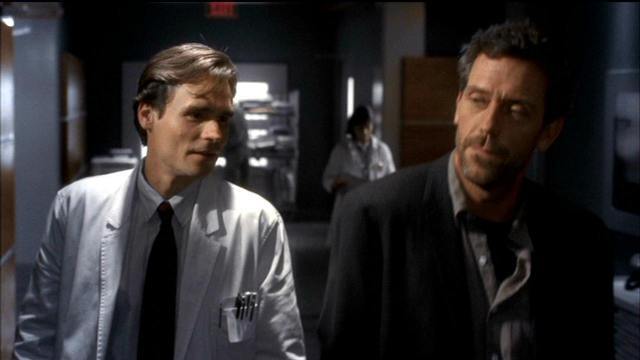
On a side note, one of my favorite clinic patients appeared in this episode:


Saturday, July 30, 2011

Pharmacology Review via The X-files

I know it seems like I've been watching a lot of TV lately but I've been working on another book and my project for my externship.   I was watching the episode  "Eve" of The X-files and, despite the myriad scientific mistakes, I found a minor medical mistake that I can't let go of.  During the episode, Mulder mentions that traces of digitalis are found on the victims that is from a South american plant and used as a paralytic.  Mulder is clearly referring to curare, not digitalis.  Curare is a nicotinic acetylcholine receptor antagonist, blocking the signals for muscle contraction.  Curare is used in arrows by indigenous South Americans to paralyze victims/prey.

That being said, digitalis is from the foxglove plant as mentioned in the episode.  However the foxglove plant is found in Europe, Asia, and some of Africa.  It contains a cardiac glycoside that inhibits the Na+/K+-ATPase.  This removes the Na+ gradient that is necessary to drive Na+/Ca2+ exchange.  Ca2+ remains in the cardiac myocyte prolonging contraction.  Digitalis has been used in congestive heart failure in the past but has been replaced with much safer medications.

Now, I probably couldn't let this go because pharmacology and physiology are some of my favorite aspects of medicine.  That doesn't mean the episode was not enjoyable (in fact, it was highly enjoyable).  As an avid fan of science-fiction, suspending disbelief and forgiving understandable mistakes is routine for me.  What I really am there for is the story and the characters.


Tuesday, July 19, 2011

Good Episodes of House, M.D.: The Pilot

I actually started watching House, M.D. during reruns of the second season.  Even in high school, I recognized how far-fetched some of the portrayals of medicine were but also appreciated that the show was much smarter than most medical dramas (especially Grey's Anatomy).  Mysteries have always been my thing and I always love a good detective-type character, especially those who pay homage to Sherlock Holmes like House does (think about it: House = Holmes, Wilson = Watson; maybe the fellows = the Baker Street Irregulars?)

My mom got me the first season for my birthday which I found really good.  Of course, you need to suspend your disbelief on a couple things:
1) No real hospital administrator would tolerate Dr. House.
2) Technologists and nurses handle a lot of things like MRIs and blood draws but there needed to be a vehicle for conversation for the fellows with each other, the patient, and/or House.
3) Princeton-Plainsboro has an interesting set up that appears to give its doctors a salary and make them do clinic duty.  I have not really encountered such a setup but it provides for good television.

Once you get over that, the process of coming up with a differential diagnoses and  thinking through medicine is actually quite good (at least for television which never shows this part).  A few years ago I started following the blog of a doctor who evaluates all the House episodes for their medical merit (http://www.politedissent.com/).  It has been really helpful as a student to read his stuff and sort through the crap of each episode.  He also reads comics which is awesome.

In the pilot episode, a woman named Rebecca Adler (another Holmes reference to Irene Adler, the only woman who ever got the better of him) becomes aphasic and seizures during class.  The aphasia goes away eventually but no one seems to be able to find out what's going on with her which is how she comes to House. After several missteps, avoidance of patient contact, and illegal breaking and entering, House leaps to the idea that she has a tapeworm from eating pork products (which I am guessing wasn't really considered because she was assumed to be Jewish because Wilson lied about his relation to her but it could have also just been that pork triggered tapeworm in House's mind which really is the way it works sometimes).  The medicine, itself, is a little haphazard with inferences made on the smallest of details but to be honest, I've seen worse in real life.  The reality is that there is a lot of uncertainty in medicine and House navigated it in his own way that is conveniently entertaining for television.  

Monday, July 4, 2011

TV Doctors: Dr. Tobias Fünke

David Cross as Tobias 
Today I am doing something new.  Lately I've been thinking about TV doctors.  Yesterday, I rewatched the first episode of Arrested Development which features the hilarious David Cross as Dr. Tobias Fünke, one of the funniest TV doctors (although his licence has been taken from him and he doesn't really practice during the show's run).


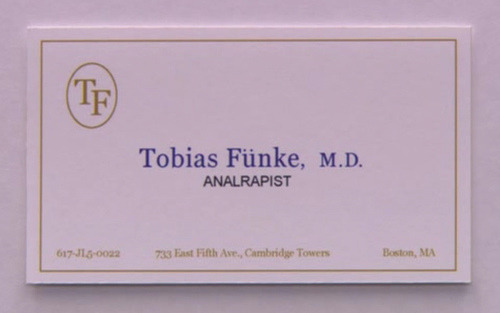
Tobias' record is impressive and perhaps that's the humor in it.  He was a chief psychiatry resident at Massachusetts General Hospital (one of the most prestigious hospitals in the nation).  Tobias was additionally trained in psychoanalysis and psychotherapy making him an "analrapist".  Tobias lost his licence when he gave CPR to a man that was not really having a heart attack.  I am not sure if a doctor can lose his licence over something like this but then again, most doctors are well trained enough to tell the difference if someone is having a heart attack or not.  Given Tobias' oblivious nature, I can probably safely assume there is more to his loss of licence (like his oblivious nature).